Family Vocation
Increasingly, Canadian households are eschewing corporate charities in favour of launching their own grassroots organizations. Inside the complex world of doing good, family-style.
The Harper government wants to supercharge the Canadian economy by allowing over 200 tankers a year through the waters off British Columbia. Detractors of the so-called Northern Gateway insist a single oil spill is all it would take to destroy one of the world’s most diverse natural environments. Is the payoff worth the risk?

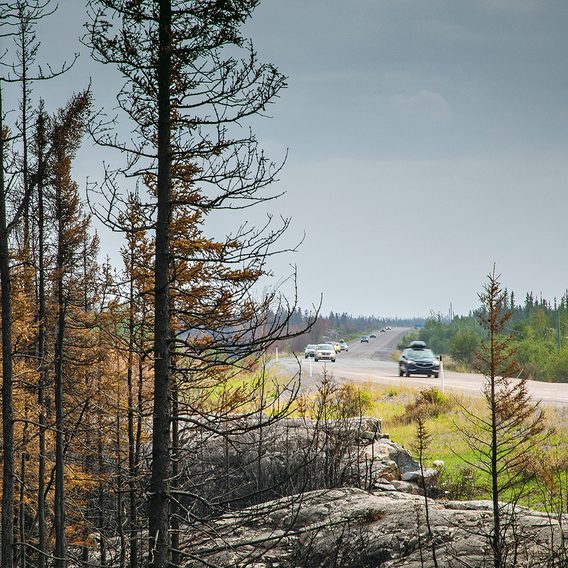
Photo: Ilja Herb
A federal decision on the Northern Gateway is expected in 2014. Hanging over it is the question of an oil spill. Or rather, questions: how likely, how big and how costly to clean up? In 1989, the Exxon Valdez spilled a quarter of a million barrels into volatile waters nearly identical to those found throughout the Northern Gateway’s proposed route, contaminating almost 2,000 kilometres of pristine Alaskan shoreline. More than 11,000 people were recruited for cleanup operations that lasted three years. Almost a quarter century later, the herring fishery in Prince William Sound, which received the brunt of the spill, is still closed. Salmon fisheries and shellfisheries remain stunted, and you can still scoop up oil with your hands on beaches more than 700 kilometres from where the tanker ran aground.
Afraid that British Columbia could be next to host such a scenario—the plan potentially endangers some 900 kilometres of Canadian coastline—a broad coalition has assembled to fight the Northern Gateway. Over 130 First Nations have registered their opposition by signing the Save the Fraser Declaration, and environmental groups from Greenpeace to the David Suzuki Foundation have co-ordinated marketing campaigns, online petitions and rallies. Scientists and researchers with decades of experience in marine systems have also spoken up.
One of them is Barb Faggetter, an oceanographer with a 20-year career on the B.C. coast. She was commissioned to analyze the Northern Gateway proposal on behalf of northern British Columbia’s fisheries’ union, and she believes it’s a bad deal. “The unknowns are huge,” she says. “The ecological impact might be light, but negative impact in the event of an oil spill could just as easily be devastating.”
Jay Ritchlin, director general of Western Canada at the David Suzuki Foundation, agrees. Ritchlin and his team ran through simulations of the effects that oil spills of varying sizes and types would have on the coast. Each result—always kept to the most conservative, “best case” scenario—wreaked havoc on the area’s fish, shellfish and whales. “Enbridge’s project,” Ritchlin says, “poses a significant threat to the region’s enormous biodiversity and to the thriving economy and ecotourism that biodiversity sustains.”
Last January, Oliver published an open letter denouncing Northern Gateway critics as “radical groups” determined to stop the project despite the cost “in lost jobs and economic growth.” The Economist, reporting on the controversy a few months before that, had described the opposition as “an outbreak of Nimbyism.” The anti-Enbridge camp maintains, however, that this is no
ordinary backyard. Spanning a dozen mountain ranges and hundreds of rivers and streams, British Columbia’s untracked wilderness poses a greater engineering challenge than Enbridge—which operates more
than 24,500 kilometres of crude-oil pipeline across North America—has ever faced.
Indeed, the company’s record is not encouraging. On July 25, 2010, an Enbridge pipeline ruptured near Michigan’s Kalamazoo River. When alarms sounded, company technicians blamed it on an air bubble, and boosted flow pressure. By the time the two-metre tear was detected—nearly 17 hours after the incident—20,000 barrels of oil had contaminated a 61-kilometre stretch of the river. With cleanup costs reaching $800 million, it remains the most expensive onshore pipeline spill in U.S. history.
The Northern Gateway pipeline route, however, is only part of the worry. It’s in Kitimat where the most fraught portion of the shipment would start—where the oil sets out to sea. Notwithstanding the Kalamazoo River catastrophe, pipeline spills rarely exceed a few hundred barrels because technicians can turn off the tap the moment they discover a leak. Compromised oil tankers, by contrast, can spew hundreds of thousands of barrels into the ocean. And British Columbia’s geography makes such concerns real. If the project is approved, oil tankers will first have to navigate a series of island-pocked, reef-strewn channels famous for heavy currents that change directions every six hours with the tide. After running this narrow, 105-kilometre gauntlet, the tankers will cross Hecate Strait, described by Environment Canada as “the fourth most dangerous body of water in the world.” This is due to the hurricanes that drop in with little notice, on waters so shallow the ocean bottom is often exposed in the troughs between waves. Few ships could sail away from a bottom strike.
Enbridge has tabled an exhaustive plan to minimize the risk of 270,000-tonne tankers running into trouble in these waters. Among other things, Enbridge’s fail-safe strategy calls for all tankers to be double-hulled; each would be accompanied by two “supertugs”—immensely powerful tugboats that would haul a tanker to safety or push it like a bumper car—throughout their passage in the confined channels of interior waters; each tanker’s load would be held in segregated tanks, meaning that if one were to rupture, only a portion of the total shipment would be compromised; operational weather limits would bar tankers from travelling in excessive sea conditions; pilots and tug crews would undergo simulator training; and a radar system would be installed to link up with the Coast Guard’s central command.
These measures lead to the final calculation that a major tanker spill (250,000 barrels or more—same as the Exxon Valdez) could be expected once every 15,000 years. In the past 10 years, five major vessels have sunk, run aground or experienced collisions along this same route. But somehow, using security measures tested only in computer simulations, 220 oil tankers with individual holding capacities of up to two million barrels are expected to transit through each year, without incident, and reach the open Pacific? Few locals are willing to bet on it.
(Article continues on next page)
Click here to see a larger copy of the map.
Looking for more great advice? Sign up to our newsletter for more useful tips, delivered straight to your inbox.
Increasingly, Canadian households are eschewing corporate charities in favour of launching their own grassroots organizations. Inside the complex world of doing good, family-style.
0 comments
The wait is over, and we’re pleased to announce the winners of Canada’s Most Interesting Towns contest.
0 comments
He’s the son of a political giant and the new hope for the beleaguered Liberal party. But who is Justin Trudeau?
2 comments
While shadowing Liberal Party leadership contender Justin Trudeau for our April cover story, Philip Preville went toe-to-toe with him in the ring.
0 comments
Cybervigilantes and hackers argue that 21st-century crimes are happening in a universe where traditional law-enforcement methods are obsolete. How the digital age is forcing police to step up their game.
0 comments
The next generation of robots is poised to acquire the very thing that makes us human: our empathy.
0 comments
Yoga star Eoin Finn believes he’s found a way to be the happiest, fittest Canadian. Now he wants to convince the rest of us.
1 comment
At 16 weeks, Logan Hampson fell mysteriously ill. Four years later, his baby sister, Alyson, developed the same symptoms. Discover the true story of what a mother and father sacrificed for their children.
2 comments
As doctors fight for the final say, the latest neuroscience is redrawing the boundaries of life and death while revealing a scary truth—that maybe we shouldn't be so quick to pull the plug.
2 comments
After decades of child abuse scandals, a new generation of Catholic leaders has vowed to turn things around. Meet the new church of zero tolerance.
4 comments
We disinfect, we sterilize, we pasteurize. We've made bacteria Enemy No. 1, but playing it safe might be what's making us sick.
0 comments
What does it take to get a clean bill of health in our two-tiered health-care system? Luc Bouchard found out first-hand why being a "patient" patient could be a life-threatening decision.
3 comments
When a college student smashed his head on a mountain rock in the middle of the wilderness, his chances of surviving were low. To save him, his girlfriend did the impossible.
0 comments
Falsely implicated in a 1965 murder, Joseph Salvati spent 30 years in prison after being sentenced to life in prison with no possibility of parole. He was innocent - and the FBI knew it all along.
0 comments
New science suggests musical therapy could be a drug-free solution to many common ailments. Can a listen a day really keep the doctor away?
0 comments
Advertisement
Enter the "Spring Into Health" contest for a chance to win 1 of 3 prizes!
Enter for a chance to win a 4-night stay for two at the Fairmont Chateau Whistler
Enter for a chance to win a Hallmark prize pack worth $500, and be featured in a future issue of Our Canada magazine!
Advertisement

Post a comment
14 comments
My problem is not with the progress, or with Trade with China. My problem lies in the route Enbridge insists on taking, and the sneaky attitude of our PM concerning the FIPA deal. It's as easy as sending the tankers out of Prince Rupert Port, and sending the pipeline in the same direction a gas-line already exists...through the Skeena Valley. However, to save money Enbridge decided to drive the pipeline in a straight line through our Province, through three salmon supporting streams and through huge Indian territories (without their knowledge or consent) to a famously perilous harbor, full of jagged rocks and Islands. Meanwhile, Harper sneaks off to China and attempts to sign our resources and land rights away, to China without our knowledge or consent. But he doesn't stop there! Then he goes forward and fires all environmental scientists, calls David Suzuki and eco-terrorist and audits him, and creates a massive omnibus bill to open up all development without delay, whether we want it or not. You call that *progress*? I call it a dictatorship in the name of unbridled resource development. Google the map, and take a look at the harbor outside Kitimat, and then take a look at that massive, well used and well maintained port *right above it. What's the deal here?
I don't have a problem with progress, but the companies need to spend $$ on explaining things to local communities and towns and environment committees, organizations and so forth. There are benefits to having this pipeline, jobs are created, but is the company doing everything possible to reassure us that if a break in the pipeline or delivery mishap developes, what are the steps that are going to be taken to fix the problem. most people like myself just want to know that the environment is going to be protected and if anything happens while Enbridge is developing this pipeline, and they will, they will have to be prepared to answer to us Canadians. I understand that our resources are precious, but we don't develop enough of them to make it work, so other companies from either another province or country . Bottom line=$$$
Thank you Arno for another brilliant article on the story of our time. You bring an impeccable sense of reason to the issue in both this article and in your Global TV appearance. Such exacting words of clarity, brevity and direction. I look forward to reading more from you and await the release of your next book, "Oil Man and the Sea". In solidarity, Matt
Trina, it's not if, but when. And as far as "the steps they are going to take to fix the problem" goes, think about the Gulf accident and the one in Michigan. They still haven't finished cleaning those up, and are fight the courts over the clean up costs. They really don't care about that. Have you seen the map they published where they blanked out most of the islands on the route thru the gateway trying to make it look like a simple, safe, direct trip?
I wonder how much the author of this article received from BIG OIL for writing this article. Enbridge has horrible history of oil spills, please research that. How long ago did the BP oil spill happen? and we are just starting to see its effects. most people must have forgotten about it because mainstream media doesn't find it essential to cover the stories of mutant sea life and lingering oil in our waters. Northern Gateway only offers temporary benefits. Temporary jobs for foreign workers mostly, because they can be paid less. This can already be seen at the Tar Sands. Temporary self satisfaction. We would never see any of that money, believe me. This temporary project doesn't live up to the value tourism, the fishing industry guarantee us. Would we really want to destroy our own backyards for money that won't benefit us in any way?
Find another way to make money. They exist. We are not that low on either inspiration or ingenuity. It is just not possible that we as a species can't come up with something better. In fact, we likely have, and it's been silenced in the time-honoured tradition of US based corporate interests. No reason to buy the biz-as-usual line that we need oil - we're just used to oil, ewe don't NEED it. The world does not need more oil. Our children don't need the devastation that has been clearly revealed by more arms-length studies by more qualified people than one readily imagines, for longer than most people know (science and modeling not, BTW, funded by the Koch Bros or industry-related interests).
$86 million annually, you say? Why, that's almost 1/10 of what BC's carbon tax brought in last year! And since their tax is revenue neutral, the same amount of money was reimbursed to British Columbians through a low income tax credit, a 5% reduction in the first two personal income tax brackets, the Northern and Rural Homeowner benefit, and business tax cuts, both general and specific to small businesses. Yup, my neighboring Province has North America's best-designed carbon tax! (My own Province of Alberta, meanwhile, has a far more timid and mysterious mechanism for pricing carbon; it only directly affects 67 companies, the revenues get recycled in an old-boy's club and the cost hasn't changed in five years.)
RD has obviously taken a position against this pipeline; this is clearly an anti-pipeline position with no balance that the RD reader can use to reach an informed decision; presenting one sided testimony, with only infrequent and token reference to safety measures being proposed, then presenting hazy arguments against even those concessions... I thought, all these years as an RD subscriber, that the editorial staff were dedicated to a more balanced presentation, but now I see the typical left-media agenda, and will cancel my subscription, and my gift subscriptions. RD is no longer acceptable reading for me.
Enbridge and the government have a great plan and there will be not oil spills. However, if there is a major oil spill the environmental costs will be horrendous and you can't go back in time. Easy to make guarantees but not so easy to replace what will be lost. What will they pay out to those who live in the area if there is a major spill? Not enough and money can't replace polluted water, environment and dead animals and fish.
Awesome article. It affects many urgent problems. It is impossible to be indifferent to these problems.
You obviously haven't read the article.
Just ask Michigan how good there pipe line is?
What a mess it made when it broke there and spilled oil all over the place
you don't understand the damage that is going to be created if this pipeline doesn't go thru the oil is already being shipped across the rocky mountains it is being done by train and if you look at the fact that north America has 3 train derailments a day you are going to see oil dispursed in smaller amounts over a larger area then you would see from a large leek from a pipeline BC recieves no moneys from oil shipped by train and would have to pay for clean up for years after numerouse derailments deposited all over the rockies from derailed trains which happens yearly during winter
Enbridge has no backup plan and nothing is being developed (as far as I know) toward 'ensuring the protection of the environment'. This project is not only short-sighted it is reckless greed. If you really want to know about Enbridges track record research the Kalamazoo River spill in Michigan. We are not just talking petroleum. This stuff is thick glob. The cost to the taxpayer when the shit hits the fans will outweigh any amount of job creation and economic prosperity. We haven't even discussed the issue of tailings, water usuage and CO2 emissions from this low-grade fossil fuel. Canadians are smart -- surely they can create a better economic industry that won't choke the planet.